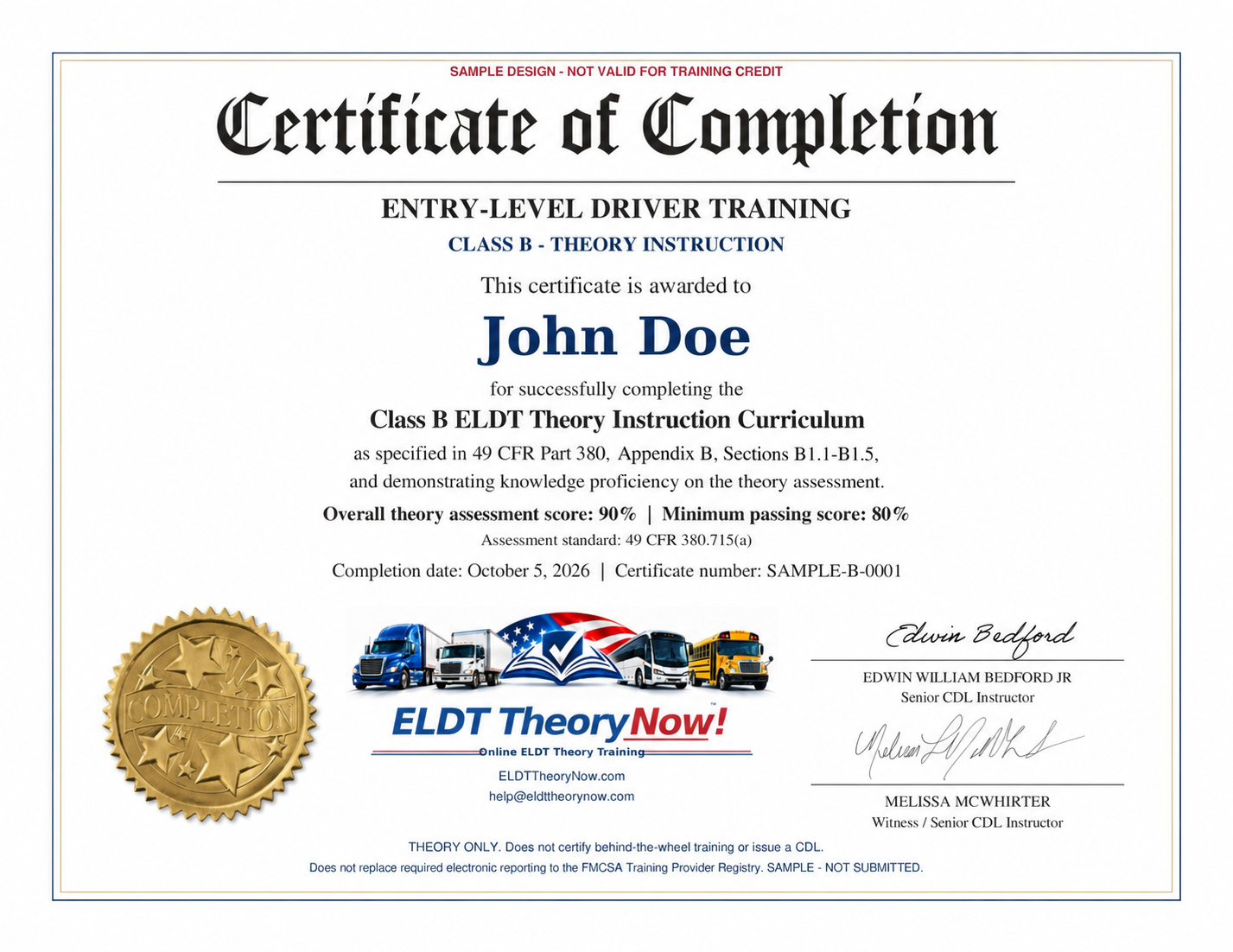
Official curriculum text reproduced from FMCSA’s requirements in 49 CFR Part 380, Appendix B. Retrieved October 8, 2026. The descriptions below quote the federal curriculum; they describe required instruction, rather than completed student training.
1. Unit B1.1.1 — Orientation
This unit must introduce driver-trainees to the commercial motor vehicle driver training curriculum and the components of a commercial motor vehicle. The training providers must teach driver-trainees the safety fundamentals, essential regulatory requirements (i.e., overview of FMCSRs/hazardous materials (HM) regulations), and driver-trainees' responsibilities not directly related to driving. This unit must also cover the ramifications and driver disqualification provisions and fines for non-compliance with parts 380, 382, 383, and 390 through 399 of the FMCSRs. This unit must also include an overview of the applicability of State and local laws relating to the safe operation of the CMV, stopping at weigh stations/scales, hazard awareness of vehicle size and weight limitations, low clearance areas (e.g., CMV height restrictions), and bridge formulas.
Official source: 49 CFR Part 380, Appendix B ↗2. Unit B1.1.2 — Control Systems/Dashboard
This unit must introduce driver-trainees to vehicle instruments, controls, and safety components. The training providers must teach driver-trainees to read gauges and instruments correctly and the proper use of vehicle safety components, including safety belts and mirrors. The training providers must teach driver-trainees to identify, locate, and explain the function of each of the primary and secondary controls including those required for steering, accelerating, shifting, braking systems (e.g., ABS, hydraulic, air), as applicable, and parking.
Official source: 49 CFR Part 380, Appendix B ↗3. Unit B1.1.3 — Pre- and Post-Trip Inspections
The training provider must teach the driver-trainees to conduct pre-trip and post-trip inspections as specified in §§ 392.7 and 396.11, including appropriate inspection locations. Instruction must also be provided on enroute vehicle inspections.
Official source: 49 CFR Part 380, Appendix B ↗4. Unit B1.1.4 — Basic Control
This unit must introduce basic vehicular control and handling as it applies to commercial motor vehicles. This unit must include instruction addressing basic CMV controls in areas such as executing sharp left and right turns, centering the vehicle, maneuvering in restricted areas, and entering and exiting the interstate or controlled access highway.
Official source: 49 CFR Part 380, Appendix B ↗5. Unit B1.1.5 — Shifting/Operating Transmissions
This unit must introduce shifting patterns and procedures to driver-trainees to prepare them to safely and competently perform basic shifting maneuvers. This unit must teach driver-trainees to execute up and down shifting techniques on multi-speed dual range transmissions, if appropriate. The training providers must teach driver-trainees the importance of increased fuel economy achieved by utilizing proper shifting techniques.
Official source: 49 CFR Part 380, Appendix B ↗6. Unit B1.1.6 — Backing and Docking
This unit must teach driver-trainees to back and dock the vehicle safely. This unit must cover “Get Out and Look” (GOAL), evaluation of backing/loading facilities, knowledge of backing set ups, as well as instruction in how to back with use of spotters.
Official source: 49 CFR Part 380, Appendix B ↗7. Unit B1.2.1 — Visual Search
This unit must teach driver-trainees to visually search the road for potential hazards and critical objects, including instruction on recognizing distracted pedestrians or distracted drivers. This unit must include instruction in how to ensure a driver-trainee's personal security/general awareness in common surroundings such as truck stops and/or rest areas and at shipper/receiver locations.
Official source: 49 CFR Part 380, Appendix B ↗8. Unit B1.2.2 — Communication
This unit must teach driver-trainees how to communicate their intentions to other road users. Driver-trainees must be instructed in techniques for different types of communication on the road, including proper use of headlights, turn signals, four-way flashers, and horns. This unit must cover instruction in proper utilization of eye contact techniques with other drivers, bicyclists, and pedestrians.
Official source: 49 CFR Part 380, Appendix B ↗9. Unit B1.2.3 — Distracted Driving
This unit must instruct driver-trainees in FMCSRs related to distracted driving and other key driver distraction driving issues, including improper cell phone use, texting, and use of in-cab technology (e.g., §§ 392.80 and 392.82). This instruction will include training in the following aspects: Visual attention (keeping eyes on the road); manual control (keeping hands on the wheel); and cognitive awareness (keeping mind on the task and safe operation of the CMV).
Official source: 49 CFR Part 380, Appendix B ↗10. Unit B1.2.4 — Speed Management
This unit must teach driver-trainees how to manage speed effectively in response to various road, weather, and traffic conditions. The instruction must include methods for calibrating safe following distances under an array of conditions including traffic, weather and CMV weight and length.
Official source: 49 CFR Part 380, Appendix B ↗11. Unit B1.2.5 — Space Management
This unit must teach driver-trainees about the importance of managing the space surrounding the vehicle under various traffic and road conditions.
Official source: 49 CFR Part 380, Appendix B ↗12. Unit B1.2.6 — Night Operation
This unit must instruct driver-trainees in the factors affecting the safe operation of CMVs at night and in darkness. Additionally, driver-trainees must be instructed in changes in vision, communications, speed, space management, and proper use of lights, as needed, to deal with the special problems night driving presents.
Official source: 49 CFR Part 380, Appendix B ↗13. Unit B1.2.7 — Extreme Driving Conditions
This unit must teach driver-trainees the specific problems presented by extreme driving conditions. The training will emphasize the factors affecting the operation of CMVs in cold, hot, and inclement weather and on steep grades and sharp curves. The training providers must teach driver-trainees the proper tire chaining procedures in this unit.
Official source: 49 CFR Part 380, Appendix B ↗14. Unit B1.3.1 — Hazard Perception
The unit must provide instruction for recognizing potential hazards in the driving environment in order to reduce the severity of the hazard and neutralize possible emergency situations. The training providers must teach driver-trainees to identify road conditions and other road users that are a potential threat to the safety of the CMV and suggest appropriate adjustments. The instruction must emphasize hazard recognition, visual search, adequate surveillance, and response to possible emergency-producing situations encountered by CMV drivers in various traffic situations. The training providers must also teach driver-trainees to recognize potential dangers and the safety procedures that must be utilized while driving in construction/work zones.
Official source: 49 CFR Part 380, Appendix B ↗15. Unit B1.3.2 — Skid Control/Recovery, Jackknifing, and Other Emergencies
This unit must teach the causes of skidding and jackknifing and techniques for avoiding and recovering from them. The training providers must teach the importance of maintaining directional control and bringing the CMV to a stop in the shortest possible distance while operating over a slippery surface. This unit must provide instruction in appropriate responses when faced with CMV emergencies. This instruction must include evasive steering, emergency braking, and off-road recovery, as well as the proper response to brake failures, tire blowouts, hydroplaning, and rollovers. The instruction must include a review of unsafe acts and the role the acts play in producing or worsening hazardous situations.
Official source: 49 CFR Part 380, Appendix B ↗16. Unit B1.3.3 — Railroad-Highway Grade Crossings
This unit must teach driver-trainees to recognize potential dangers and appropriate safety procedures to utilize at railroad (RR)-highway grade crossings. This instruction must include an overview of various Federal/State RR grade crossing regulations, RR grade crossing environments, obstructed view conditions, clearance around the tracks, and rail signs and signals. The training providers must instruct driver-trainees that railroads have personnel available (“Emergency Notification Systems”) to receive notification of any information relating to an unsafe condition at the RR-highway grade crossing or a disabled vehicle or other obstruction blocking a railroad track at the RR-highway grade crossing.
Official source: 49 CFR Part 380, Appendix B ↗17. Unit B1.4.1 — Identification and Diagnosis of Malfunctions
This unit must teach driver-trainees to identify major vehicle systems. The goal is to explain their function and how to check all key vehicle systems, as appropriate (e.g., engine, engine exhaust auxiliary systems, brakes, drive train, coupling systems, and suspension) to ensure their safe operation. Driver-trainees must be provided with a detailed description of each system, its importance to safe and efficient operation, and what is needed to keep the system in good operating condition.
Official source: 49 CFR Part 380, Appendix B ↗18. Unit B1.4.2 — Roadside Inspections
This unit must instruct driver-trainees on what to expect during a standard roadside inspection conducted by authorized personnel. The training providers must teach driver-trainees on what vehicle and driver violations are classified as out-of-service (OOS), including the ramifications and penalties for operating a CMV when subject to an OOS order as defined in section 390.5.
Official source: 49 CFR Part 380, Appendix B ↗19. Unit B1.4.3 — Maintenance
This unit must introduce driver-trainees to the basic servicing and checking procedures for various engine and vehicle components and to help develop their ability to perform preventive maintenance and simple emergency repairs.
Official source: 49 CFR Part 380, Appendix B ↗20. Unit B1.5.1 — Handling and Documenting Cargo
This unit must teach driver-trainees the basic theory of cargo weight distribution, cargo securement on the vehicle, cargo covering, and techniques for safe and efficient loading/unloading. The training providers must also teach driver-trainees the basic cargo security/cargo theft prevention procedures. The training providers must teach driver-trainees the basic information regarding the proper handling and documentation of HM cargo.
Official source: 49 CFR Part 380, Appendix B ↗21. Unit B1.5.2 — Environmental Compliance Issues
This unit must teach driver-trainees to recognize environmental hazards and issues related to the CMV and load, and also make aware that city, county, State, and Federal requirements may apply to such circumstances.
Official source: 49 CFR Part 380, Appendix B ↗22. Unit B1.5.3 — Hours of Service Requirements
This unit must teach driver-trainees to understand that there are different hours-of-service (HOS) requirements applicable to different industries. The training providers must teach driver-trainees all applicable HOS regulatory requirements. The training providers must teach driver-trainees to complete a Driver's Daily Log (electronic and paper), timesheet, and logbook recap, as appropriate. The training providers must teach driver-trainees the consequences (safety, legal, and personal) of violating the HOS regulations, including the fines and penalties imposed for these types of violations.
Official source: 49 CFR Part 380, Appendix B ↗23. Unit B1.5.4 — Fatigue and Wellness Awareness
The issues and consequences of chronic and acute driver fatigue and the importance of staying alert will be covered in this unit. The training providers must teach driver-trainees about wellness and basic health maintenance information that affect a driver's ability to safely operate a CMV.
Official source: 49 CFR Part 380, Appendix B ↗24. Unit B1.5.5 — Post-Crash Procedures
This unit must teach driver-trainees the appropriate post-crash procedures, including the requirement that the driver, if possible, assess his or her physical condition immediately after the crash and notify authorities, or assign the task to other individuals at the crash scene. The training providers must teach driver-trainees how to protect the area; obtain emergency medical assistance; move on-road vehicles off the road in minor crashes so as to avoid subsequent crashes or injuries; engage flashers; place reflective triangles and other warning devices for stopped vehicles; and properly use a fire extinguisher, if necessary. The training providers must instruct driver-trainees in post-crash testing requirements related to controlled substances and alcohol.
Official source: 49 CFR Part 380, Appendix B ↗25. Unit B1.5.6 — External Communications
This unit must instruct driver-trainees in the value of effective interpersonal communication techniques/skills to interact with enforcement officials. The training providers must teach driver-trainees the specifics of the roadside vehicle inspection process, and what to expect during this activity. Driver-trainees who are not native English speakers must be instructed in FMCSA English language proficiency requirements and the consequences for violations. The training providers must teach driver-trainees the implications of violating Federal and state regulations will have on their driving records and their employing motor carrier's records.
Official source: 49 CFR Part 380, Appendix B ↗26. Unit B1.5.7 — Whistleblower/Coercion
This unit must teach the driver-trainees about the right of an employee to question the safety practices of an employer without incurring the risk of losing a job or being subject to reprisals simply for stating a safety concern. The training providers must instruct driver-trainees in the whistleblower protection regulations in 29 CFR part 1978. The training providers must teach driver-trainees the procedures for reporting to FMCSA incidents of coercion from motor carriers, shippers, receivers, or transportation intermediaries.
Official source: 49 CFR Part 380, Appendix B ↗27. Unit B1.5.8 — Trip Planning
This unit must address the importance of and requirements for planning routes and trips. This instruction must address planning the safest route, planning for rest stops, heavy traffic areas, railroad-highway grade crossing safe clearance and ground clearance (i.e., “high center”), the importance of Federal and State requirements on the need for permits, and vehicle size and weight limitations. The training providers must teach driver-trainees the correct identification of restricted routes, the pros and cons of Global Positioning System (GPS)/trip routing software, and the importance of selecting fuel-efficient routes.
Official source: 49 CFR Part 380, Appendix B ↗28. Unit B1.5.9 — Drugs/Alcohol
This unit must teach driver-trainees the rules applicable to controlled substances (including prescription drugs) and alcohol use and testing related to the operation of a CMV.
Official source: 49 CFR Part 380, Appendix B ↗29. Unit B1.5.10 — Medical Requirements
This unit must teach driver-trainees the Federal rules on medical certification, medical examination procedures, general qualifications, responsibilities, and disqualifications based on various offenses, orders, and loss of driving privileges (49 CFR part 391, subparts B and E).
Official source: 49 CFR Part 380, Appendix B ↗